Not in every case. Organic product visibility and paid advertising are separate channels. AI systems use product information from different sources without requiring an active advertising campaign.


How to Prepare Your Online Store for Sales Through ChatGPT and Google AI
Table of contents
The way people search for products online is changing. Instead of browsing multiple websites and product pages, users increasingly describe what they are looking for directly to ChatGPT, Gemini, and other AI systems.
For online stores, this creates a new requirement. Product information needs to be clear not only to visitors and search engines, but also to AI systems that find, compare, and recommend products.
In 2026, specific technologies already support this process. OpenAI is developing the Agentic Commerce Protocol, or ACP, while Google is working with the Universal Commerce Protocol, or UCP. Both standards focus on accurate product data and the connection between product selection and purchase.

How AI Is Changing Product Search
In traditional search, users often enter a short query such as "men's hiking shoes."
In a conversation with AI, the query becomes more specific:
"I'm looking for lightweight waterproof hiking shoes for summer, suitable for long walks and priced under €150."
To provide a relevant result, the AI system needs to understand the intended use, features, price, and other conditions.
This is why a product page containing only a name, image, and price now provides too little information. Material, size, intended use, availability, variants, delivery details, and other attributes help systems understand when a product matches a specific search.
This is where SEO, GEO optimization, and product data quality begin to serve the same goal.

Selling Through ChatGPT and the Role of ACP
OpenAI uses the Agentic Commerce Protocol as infrastructure connecting merchants, product catalogs, and AI services.
Product discovery is an important part of this process. ChatGPT needs access to up-to-date product information in order to present relevant products when users search for them.
Selling through ChatGPT does not necessarily mean the entire purchase process takes place inside the conversation. Depending on the integration, a user selects a product through ChatGPT, after which the purchase continues through the ordering method supported by the merchant.
For this reason, having an ACP integration alone is not enough. A well-maintained product catalog remains the foundation.
Why the Product Feed Matters
A product feed is a structured collection of product information. It provides external systems with data about what you sell and under what conditions.
It usually includes:
- product name and description
- price and currency
- availability
- images
- brand and category
- size, color, and other variants
- product identifiers
- URL
- current offers
Accuracy matters more than the amount of information.
A product called "Model X100" with two images and a price provides little context. If the description explains the product type, intended use, features, and differences between variants, the AI system has far more information to present the product correctly.
Selling Through Google AI and UCP
Google is developing the Universal Commerce Protocol for commercial interactions through services such as Gemini and AI Mode in Google Search.
Selling through Google AI also starts with a structured product catalog. Google Merchant Center plays an especially important role, as it needs to contain up-to-date information about products, prices, availability, delivery, and returns.
Direct UCP integration also involves technical requirements, including API operations and a UCP profile through which the store describes its supported functions.
As of August 2026, integration with AI Mode and Gemini requires approval from Google. A Merchant Center account alone does not automatically activate selling through Google AI.
What to Check in Google Merchant Center
Differences between your store data and Merchant Center create a risk that the AI system will use outdated or inaccurate information.
Check whether:
- prices in the store and product feed match
- availability is updated regularly
- brands and product identifiers are completed
- categories are clearly defined
- images accurately represent the product
- delivery and return conditions are up to date
A well-organized Merchant Center now matters beyond Google Shopping and advertising campaigns.
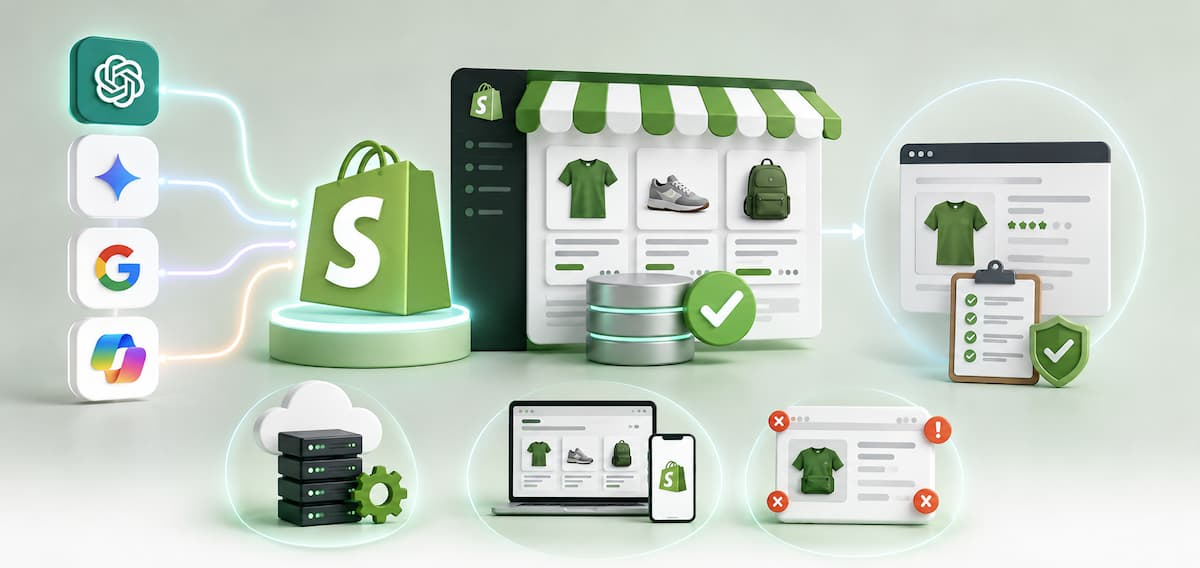
Shopify and AI Sales
Shopify is developing Agentic Storefronts, which connect product catalogs with AI channels such as ChatGPT, Gemini, Google AI Mode, and Microsoft Copilot.
A large part of the technical infrastructure is managed by the platform. This makes the process easier for stores without an in-house development team.
The platform does not solve problems with product content. An unclear title, incomplete description, or incorrect availability remains a problem regardless of the integration.
Good preparation starts with the catalog itself.
How to Prepare a WooCommerce Store
With WooCommerce, the store owner has greater control over the technical infrastructure. As a result, preparation requires more attention.
Practical steps include keeping WordPress and WooCommerce up to date, synchronizing with Google Merchant Center, maintaining accurate product data, and providing clear delivery and return information.
Google for WooCommerce is one option for synchronizing products with Merchant Center.
For stores connected to an inventory management system, availability should update automatically. If an AI system presents a product as available while the product page shows otherwise, the customer receives conflicting information.
Structured Data Remains Important
Test your store in AI as a real customer would
Open ChatGPT and Gemini and, instead of searching for your store name or a specific product, ask a question the way a real customer would.
For example: "I'm looking for waterproof hiking shoes for long hikes under €150. Which models are suitable?"
Then check whether one of your products appears among the recommendations and whether the AI describes its price, features, brand, and intended use correctly.
If the product does not appear or the information is incomplete, repeat the test using several different queries. This is a quick way to see how AI systems understand your product catalog and where clearer product data, descriptions, or GEO optimization are needed.
AI Commerce Does Not Replace Technical SEO
Product Structured Data provides machine-readable information about price, availability, brand, ratings, and other product attributes.
This data should match the visible content and the product feed.
If the website shows one price, the schema markup shows another, and Merchant Center shows a third, external systems receive conflicting signals.
A better approach is to maintain one primary source of product information from which the other systems receive up-to-date data.
SEO and GEO in AI-Driven Sales
Technical Integration Is Only Part of the Preparation
The AI system needs to understand why a particular product is suitable for a specific user. For this reason, the product page should clearly explain what the product is, who it is intended for, which features it has, how it is used, and how it differs from similar options.
The name "Model TR500" provides little information.
"TR500 waterproof men's hiking shoes" provides clear context directly in the title.
The same principle applies to descriptions. Instead of mechanically repeating keywords, the content should answer the questions customers ask before making a purchase.
What to Prepare Right Now
You do not need direct selling through ChatGPT or Google AI to be available to every store before starting your preparation.
Review your product categories, descriptions, specifications, prices, availability, images, structured data, and Merchant Center setup. Add clear delivery and return conditions. Maintain strong internal linking and technically accessible product pages.
After that come the specific ACP and UCP integrations, depending on the platform and market.
Prepare the Store, Not Only a Single AI Channel
ACP and UCP are important technologies in 2026, but building an online store around one specific AI service is not a sensible approach.
A more stable approach is to keep product data accurate, structured, and easy for different systems to process.
When the catalog is well organized, adding a new AI channel becomes easier. When product data is disorganized, every new integration creates additional technical work.
Selling through ChatGPT and selling through Google AI add a new channel to e-commerce, but the foundation stays the same: a well-maintained catalog, up-to-date data, solid technical implementation, and content that answers real customer questions.
At Studio Kipo, we work on online stores, SEO, and GEO optimization. If you would like to assess how prepared your store is for AI product search and what changes are needed, contact us.
Share


FAQ:
Do I need to pay for advertising for my products to appear in AI results?

Are AI sales suitable for small online stores?
Yes. A smaller product catalog is often easier to maintain when the information for each product is well organized. The quality and accuracy of product data matter more than the number of products.
How do I measure visits and orders coming from AI platforms?
Tracking is possible through the store’s analytics system, referral data, URL parameters, and order information. During the initial setup, define how AI traffic will be separated from organic search, paid advertising, and direct visits.
Is the same product able to appear on several AI platforms at the same time?
Yes. Store preparation should not focus on a single system. Well-organized product data allows the same catalog to work across search engines, AI services, advertising platforms, and commerce channels.
Does an online store’s reputation affect AI recommendations?
Yes. Business information, customer reviews, independent sources, and consistent brand presentation provide AI systems with additional context. A specific number of reviews does not automatically result in product visibility.
How does a multilingual online store affect AI product search?
Each language version should provide clear and consistent product information. Translated pages should use accurate product names, specifications, prices, and terms for the relevant market. Machine translation without human review often results in unclear or inaccurate product descriptions.
What happens when I change a price or discontinue a product?
The update should reach systems using your product data as quickly as possible. Otherwise, an AI service might temporarily display outdated information. Automated synchronization is especially important for stores with frequent price and stock changes.
How do I know whether investing in AI sales makes sense for my online store?
Start with the way customers choose your products. When a purchase involves comparing specifications, asking questions, or choosing between similar options, AI product search becomes an especially relevant channel. Track real visits, leads, and orders before allocating more resources to additional integrations.
About the author

Teo is an SEO Team Lead with 13+ years of experience in the field and a popular speaker, with a proven track record of delivering sustainable organic growth for websites and online stores. He leads strategies and trainings with a practical focus on technical SEO, content, and SERP coverage.
Related articles
Artificial Intelligence in Web Design in 2026: Opportunities, Limitations, and the Role of the Designer
Write a few sentences and AI will suggest a homepage structure, color palette, images, copy, and a working prototype. A process that once took days now starts within minutes.
This might sound like the end of traditional web design. In practice, something different is happening. The designer's role is not disappearing. It is shifting from repetitive execution towards analysis, ...

Petya
Aug 10
·
18 minute reading
GEO Optimization, AEO, and AI SEO: What’s the Difference, and Why Are They Important for Businesses in 2026?
The way people search for information is no longer limited to a list of ten Google results. More users now ask complete questions and expect a ready answer, comparison, recommendation, or specific steps. Such an answer might appear in Google AI Overviews, ChatGPT, Gemini, Perplexity, or another artificial intelligence system.
For businesses, this shift is significant. Your website now ...

Niki
Aug 2
·
14 minute reading
GEO, AEO, or SEO: how Google defines optimization for AI Overviews and AI Mode
New acronyms often appear in digital marketing and promise a revolution. In recent months, AEO, Answer Engine Optimization, and GEO, Generative Engine Optimization, have become more common. Every "expert" seems to have a new method for "hacking" artificial intelligence.
But what does Google itself say? The truth is simpler than many digital agencies want you to believe.
...
Teo
Jun 4
·
7 minute reading